
The food-safety challenge is bigger than registration
Registration tells a municipality that a business exists and is authorised to trade at a given address. Food safety asks a different question: is food being handled, stored and sold safely today, and will someone notice if it is not?
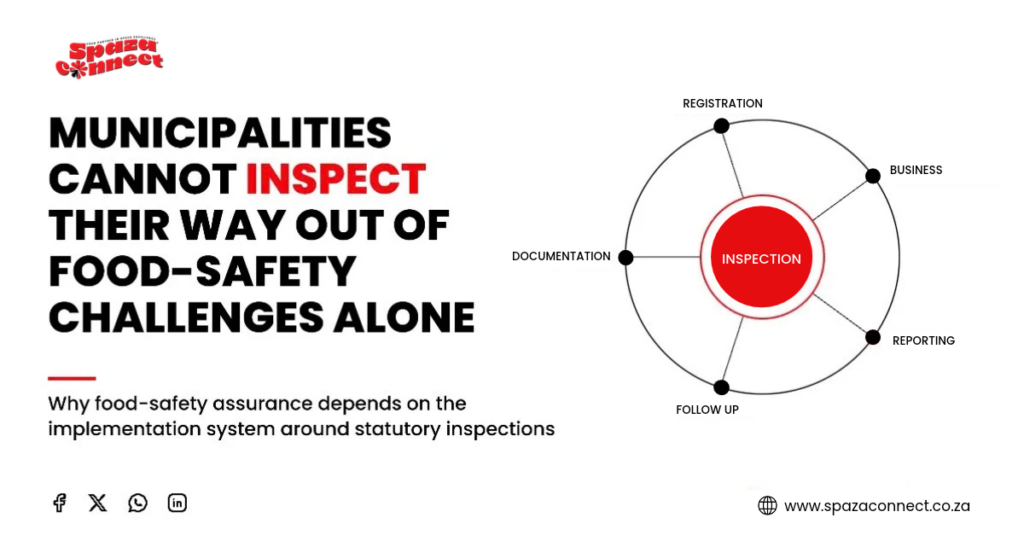
Since the child food-poisoning deaths of 2024, registration has understandably dominated the conversation. Government directed spaza shops and other food-handling businesses to register with their municipalities, and applications followed. But registration is only the entry point to a longer chain: verifying the business, assessing the premises, deciding on the application, following up on defects and keeping records current. Each link sits with a different team, and the chain is only as strong as the handovers between them.
Registration is also not the same as compliance. A trading permit, a business licence, zoning approval and a Certificate of Acceptability (COA) are separate instruments, and the combination required varies by municipality. A COA reflects the condition of premises when they were assessed; conditions change after the certificate is issued. Treating any one document as proof of full compliance leaves gaps that only ongoing follow-up can close.
Why inspections remain essential, but cannot operate in isolation
Municipal health services are a local-government function, and food-premises hygiene is governed nationally by Regulation R638 of 2018. Environmental Health Practitioners (EHPs) assess premises against it, and the municipality decides whether a COA is issued, whether a notice is served and whether enforcement follows. Nothing in this article changes that. Inspections are the statutory backbone of food-safety assurance.
The point is that an inspection is a single moment in a longer process. Its value depends on what surrounds it: whether the right premises are identified, whether files are complete when the EHP arrives, and whether findings lead to corrective action that is tracked to closure. WHO and FAO make a related point in their June 2026 joint statement for South Africa, calling for stronger surveillance and reporting alongside risk-based inspections that focus attention where risks are highest. Risk-based work requires information about where those risks are.
The pressure points: capacity, backlogs, data and follow-up
On 17 July 2026 the Public Protector released preliminary findings from a systemic investigation into food-safety enforcement in Gauteng’s informal food sector. They are preliminary: a Section 7(9) notice gives the institutions concerned an opportunity to respond before any final report, and we have not located a final report at the time of writing. The findings are also specific to Gauteng and should not be generalised to every municipality. Even so, the themes they raise are recognisable to municipal teams elsewhere, and they describe a system under strain rather than individuals failing at their jobs:
- Gauteng municipalities were reported to have fewer EHPs than the ratio recommended by WHO and the National Environmental Health Norms and Standards (one per 10,000 residents).
- Coordination and monitoring. The findings point to weak coordination between departments and gaps in the oversight structures intended to monitor municipal health services.
- Registration and environmental-health assessment are often handled by different departments running in parallel. An application can wait on either, and neither team may see the other’s queue.
- Business lists may be incomplete or out of date, and the applicant, licence holder and actual operator do not always match, which slows verification.
- Follow-up. When an assessment identifies defects, someone must track the corrective deadline, the re-assessment and the outcome. Without a shared record this depends on individual memory and spreadsheets.
Adding EHP posts is a legitimate and important response, but it is a medium-term one. In the meantime, the question for many municipalities is how to make existing capacity go further.
Why municipalities need an implementation layer
By an implementation layer we mean the connective work around statutory decisions: finding and verifying businesses, preparing complete documentation, explaining requirements in practical terms, passing structured information to the right team, tracking what happens next and reporting progress to leadership. It is not a substitute for any statutory function. It is the work that helps those functions be applied to the right businesses, with the right information, at the right time.
This is the space in which #SpazaConnect© model is designed to operate. The sections below describe each component.
What verified field data can contribute
Field engagement places Community Engagement Officers in the communities where businesses operate. They can map and geotag businesses by ward, verify basic details in person, and capture structured information in a consistent format. For a municipality, this can narrow the gap between the businesses on its lists and the businesses actually trading.
That information supports municipal prioritisation; it does not replace it. Which premises to assess first, and what an assessment finds, remain decisions for the municipality and its EHPs.
Supporting registration and documentation
Requirements differ across municipalities: in the forms used, whether applications are lodged online or in person, and in which supporting documents are requested. Implementation support therefore starts by mapping the local process, not assuming one national template.
Within that local process, help with assembling complete and consistent application files reduces stalled applications and repeat visits, which frees municipal staff to spend time on decisions rather than on chasing missing paperwork. Practical food-safety education serves the same purpose: owners who understand what R638 covers (premises condition, handwashing facilities, water and drainage, food storage and temperature control, pest control, waste and personal hygiene) are better placed to address defects before an assessment. Where a municipality requires recognised food-safety training, it determines which training it accepts.
Supporting triage, referrals and follow-up
Once a business has been verified and its documentation compiled, the case needs to reach the right municipal team in a usable form. Structured referrals give EHPs and LED officials the information they need in one place, and the municipality decides how each case is prioritised.
Follow-up is where much of the chain can break. Implementation support can help track whether a referral has been picked up, whether a corrective action has been completed and whether a case is waiting on the business or on an internal step. It records progress. It does not determine whether a business is compliant.
Creating digital visibility through case tracking and dashboards
Digital case tracking gives every case a visible status, so a business owner, a field officer and a municipal manager are looking at the same picture. Dashboards then aggregate those statuses for leadership: how many businesses are mapped by ward, how many applications are complete, how many referrals are outstanding and where cases are queuing.
Visibility is what allows managers to see where a backlog is forming and to report to councils, provincial departments and oversight bodies. How such tracking connects to a municipality’s existing systems is something to scope with each municipality, not assume.
What the #SpazaConnect© implementation experience shows
#SpazaConnect© implementation records show the following activity:
- 300+ spaza-shop owners engaged
- 53 businesses registered
- 88 shops assessed
- 10 Community Engagement Officers deployed in Mogale City
These are activity measures. They show that field engagement, registration support and structured assessment can be mobilised at scale, and they give a basis for planning capacity. They are not evidence of improved compliance or food-safety outcomes, and “assessed” here describes an implementation activity, not a statutory inspection or a compliance determination. Demonstrating outcomes would require a defined baseline and municipal data, which is part of what a structured review period is for.
The proposed 120-day municipal mobilisation framework
120 Copilot is a proposed 120-day municipal mobilisation framework: a four-month implementation roadmap that a municipality could adopt, adapt or decline. It is not a pilot, a funding programme, a regulatory mechanism, a replacement for municipal functions or a promise of municipal transformation. The full framework is set out in the 120 Copilot Explained reference section; in summary, it has four stages.
- Days 0–30, Mobilise. Agree governance and roles, map existing processes, recruit and train Community Engagement Officers, configure the platform and begin mapping businesses and wards.
- Days 31–60, Establish the baseline. Understand which businesses are registered, identify documentation and readiness gaps, gather field information and support applications and documentation.
- Days 61–90, Accelerate. Follow up outstanding cases, support referrals and EHP-related processes, track remedial actions, review backlogs and improve visibility through dashboards and reporting.
- Days 91–120, Institutionalise. Review performance, identify recurring issues, strengthen municipal processes, produce reporting and identify what could be scaled, improved or stopped next.
Throughout, the division of responsibility stays fixed:
| Municipal role | Implementation support role |
| Statutory decisions
Inspections and assessments Certificates of Acceptability Notices and enforcement Decisions on applications Case prioritisation |
Field mapping
Business verification Documentation support Practical education Structured information Referral and follow-up tracking Reporting and dashboards |
What municipalities could review after 120 days
A review at day 120 would be about whether the process is working and what to do next. Indicators a municipality might consider include:
- Businesses mapped and verified, by ward
- Completeness of documentation across open applications
- Referrals made, and the time taken for each to be picked up
- Open cases by stage, and where backlogs concentrate
- Recurring issues found across businesses and wards
- Which parts of the process to scale, improve or stop
Outcome measures, such as changes in compliance levels or foodborne-illness reports, would depend on municipal baseline data and should be agreed with the municipality rather than assumed at the outset.
Conclusion: strengthening the system around statutory functions
The question is not whether municipalities should inspect. They should, and the statutory decisions that follow remain theirs. The question is whether the wider system gives municipal teams the information, field support, coordination and visibility they need to act, follow up and manage the compliance journey effectively.
#SpazaConnect© is offered as implementation support that sits alongside those functions. If your municipality is reviewing how registration, environmental health and LED functions connect, Siyakha would welcome a conversation about whether a 120-day mobilisation framework could fit your context.
To partner with Siyakha Consulting and #SpazaConnect© to support spaza shop formalisation and township business growth, get in touch with our team at tumelo.dichabe@siyakha.co.za or visit spazaconnect.co.za to start your registration journey today.
