
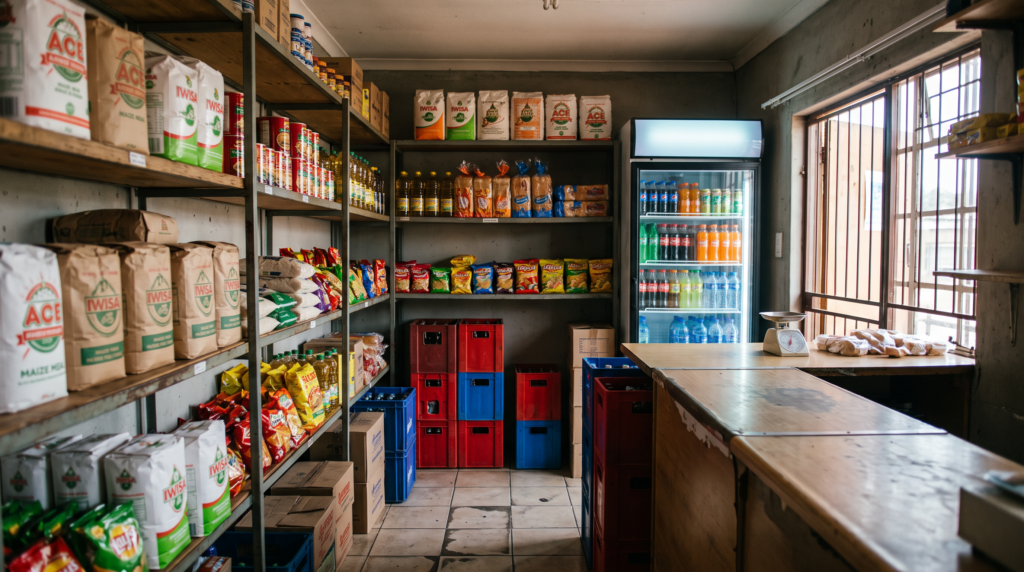
A full shelf, a full fridge or a full cooler box is not the same as being festive-ready. Picture a Friday afternoon in December: cold drinks are stacked behind the door, the fridge will not quite close and your supplier has moved Tuesday’s delivery to Thursday. In a takeaway kitchen it might be the gas running low and the chicken delivery late; at a stall, it might be the ice melting before the lunch crowd arrives. Customers are waiting, but you are still checking what arrived and what needs replacing. Preparing before the rush means making those decisions while you have time to think—not while you are serving a queue. Start with four essentials: stock, cash, food safety and documents.
Whether you run a neighbourhood spaza shop, a food establishment such as a takeaway, café or catering kitchen, or an informal stall or home-based food business, this guide is designed to help you prepare with the cash, space and equipment you have. Use it to review your orders, organise your paperwork and identify questions to take to your municipality or Environmental Health Practitioner (EHP). The practical lessons are not limited to one municipality. Local processes and requirements must still be confirmed where you trade; examples from individual municipalities are examples, not instructions for every area. Where a section says “shop”, read it as your shop, kitchen or stall, and look out for the notes written for food establishments and informal traders.
1. Why festive-season preparation should start early
Busy periods squeeze everything at once. Suppliers are busier, deliveries can slip, storage fills up and you and your helpers have less time. A missed expiry date, a fridge running warm or a bin that is not emptied is a small problem in a quiet week and a much bigger one when twice as many customers walk in.
Starting in early November gives you time to talk to suppliers while they still have capacity, sell down slow stock, repair a worn fridge seal and sort out paperwork. It also gives you time to ask questions of your municipality before you need the answers. Customers are paying attention too. Mogale City has said it is stepping up inspections and joint enforcement, and it encourages residents to check that a shop displays a Municipal Trading Licence and a Certificate of Acceptability.
2. Plan stock around demand, cash and supplier lead times
Three questions shape a sensible festive order: what sold last December, how much cash can you tie up, and how long does each supplier take?
Start with your own records. Use last year’s sales book, till slips, phone notes or supplier invoices for the busiest weeks. If you did not keep records, use your busiest weekends this year and write down what ran out. Then sort your products into three groups: fast movers that you restock constantly (for example bread, maize meal, cooking oil, sugar and cold drinks, or the ingredients behind your best-selling dishes), seasonal extras and slow lines.
Set a cash ceiling before you shop. Decide the most you can put into extra stock without struggling to pay suppliers, restock fast movers, or cover rent and electricity. Here is an illustration of the method, not a benchmark: if you can safely spend R6 000 on extra stock, you might put R4 000 into products you already know sell quickly, R1 500 into seasonal extras and keep R500 aside for top-ups in mid-December. Your own numbers will be different. The point is that every rand has a job before you walk into the wholesaler.
Ask each supplier four questions and write down the answers: What is your last order day before the busiest days? What is the minimum order? Which days do you deliver? What happens if you run out of something I order? Then choose a backup, such as a second supplier or a cash-and-carry, for your top five products. Paying slightly more for a week is often cheaper than an empty shelf.
Order in rounds where your supplier terms allow. Two or three smaller orders let you adjust after you see how the first week sells, instead of guessing the whole month in one go.
If you run a food establishment or a stall: work from your menu or your daily sales. List your best-selling dishes or items, then the ingredients, packaging, gas, charcoal or electricity and ice each one needs. Running out of one small item, such as cooking oil, gas or takeaway containers, can stop a whole menu. Buy perishable ingredients closer to the day you will use them, and sell down what you have before topping up.
3. Reduce waste, expired stock and over-ordering
Do a shelf walk this week. Take one shelf at a time, check every date and every pack, and remove anything expired. Selling expired products puts customers at risk, and it puts your shop at risk too: Mogale City has reported that expired and illicit goods were confiscated during compliance operations.
- First expiry, first out. Put new stock behind older stock and keep the earliest dates at the front. Write the expiry month in large marker pen on cartons so it can be seen from a distance (good practice).
- Check condition, not just dates. Do not sell tins that leak, bulge or are badly dented, torn or leaking packs, anything that shows signs of pests, or frozen food that has thawed and been refrozen. If you are unsure, take it off the shelf (good practice).
- Be careful with short-life stock. Do not over-order bread, milk, fresh produce, fresh ingredients or ready-to-eat items. Build your buffer from longer-life products instead.
- Keep a simple waste note. Writing down what you throw away shows you what to order less of next time.
- Plan prepared food in batches. If you cook or prepare food to sell, make what you expect to sell that day and label containers with the date they were prepared (good practice). Prepared food you cannot sell is cash thrown away, so note what is left at closing and adjust tomorrow’s batch.
4. Safe food storage, handling and temperature control
The national food-premises regulation, R638 of 2018, sets rules on how food is stored and displayed. Among other things, it says food must not touch floors or walls, and that ready-to-eat food that is not pre-packed must be protected from droplets, insects, dust and bare hands. It also sets temperature limits: as published, chilled food must be kept below 5°C (raw fish, poultry and milk below 4°C), frozen food at or below −12°C (ice cream and frozen fish at or below −18°C) and hot food at or above 60°C. Exactly how this applies to your shop depends on what you sell and where, so confirm it with your municipality or Environmental Health Practitioner (EHP), the municipal official who inspects food premises.
R638 defines food premises broadly: it includes a building, structure, stall, caravan, vehicle, stand or other place used for handling food. So whether you trade from a shop, a kitchen, a trolley or a table on the pavement, the food-safety basics matter to you. What applies in detail still depends on what you sell and where you trade.
Here is what that can look like in a small shop, kitchen or stall with limited equipment:
- Buy a fridge thermometer and use it. Touch is not a reliable test. Note the reading morning and evening so you notice a fridge that is drifting warm (good practice).
- Do not overpack the fridge. Cold air needs to circulate. Restock in small batches so the door is not open for long.
- Plan for power cuts. Interruptions to power can break the cold chain, which means chilled and frozen food stops being kept cold all the way from supplier to customer. Keep the door shut, check the temperature when power returns, and decide in advance what you will not sell if food has been too warm for too long.
- Store dry goods off the floor, away from walls, and keep cleaning products, paraffin and pest poison well away from food.
- Know your limits. If you do not have a working fridge or reliable power, it may be safer not to stock high-risk chilled items such as cold meats or dairy. Not every shop, kitchen or stall needs to stock or sell every product.
- Keep hot food hot. If you sell cooked food, plan how you will keep it at or above 60°C, the hot-food limit as published in R638, until it is sold, and how you will check it. A food thermometer is a cheap way to do that (good practice).
- Stalls and mobile traders: keep cooler boxes cold and shut. Pack chilled items with enough ice or ice packs, keep the lid closed and out of the sun, and check the contents often. If you cannot keep chilled food cold through the trading day, it may be safer not to sell it. Ask your EHP what applies to your set-up (good practice).
The World Health Organization’s Five Keys to Safer Food are a useful reminder of the basics: keep clean, separate raw and cooked food, cook thoroughly, keep food at safe temperatures, and use safe water and raw materials.
5. Prevent cross-contamination and keep cleaning, handwashing and hygiene routines
Cross-contamination happens when germs move from one food, surface or pair of hands to another. In a busy shop, kitchen or stall it usually happens by accident: raw chicken stored above cooked food, one cloth used for everything, or cash handled and then bread picked up.
- Separate raw and ready-to-eat food. Keep raw meat and chicken at the bottom of the fridge, in closed containers, away from polony, cheese and cooked food. Use separate boards, knives and containers, and wash surfaces after raw food.
- Protect ready-to-eat food. R638 says staff should avoid touching non-prepacked ready-to-eat food with bare hands unless it cannot be avoided. Use tongs, clean paper or gloves where practical. Gloves do not replace handwashing.
- Wash hands at the right moments. R638 sets out when food handlers must wash their hands, including at the start of a shift, after using the toilet and after handling raw food, rubbish or money. If you have no basin nearby, ask your EHP what your premises need. A simple set-up can be a container with a tap, clean water, soap and paper towels, but what is acceptable depends on your premises.
- Stay away from food if you are ill. R638 also sets rules for food handlers with contagious illness or open wounds, and for returning to work. Cover small cuts with a waterproof plaster and speak to your EHP about the detail.
- Wear clean clothing. R638 expects clean, suitable clothing and head coverings for people who handle food.
- Clean as you go. Wipe food surfaces and fridge shelves daily, use separate cloths for food surfaces and floors, and empty and close bins before they overflow.
- Deal with pests and waste early. R638 makes pest control, refuse removal and bin cleaning part of the duties of the person in charge. Keep stock off the floor, flatten cardboard boxes, close up gaps where you can and keep food covered.
- Think through water, waste and set-up. If you trade from a stall or vehicle, plan where your clean water comes from, where dirty water and rubbish will go, and how you will keep food covered and off the ground. Ask your EHP what your trading site needs (good practice).
- Train the people who help you. R638 expects the person in charge to make sure staff are trained in food safety and to keep training records. According to Garden Route District Municipality, training can be given by an accredited provider or by a municipal EHP. Ask your municipality what is available where you trade.
6. Organise your business and food-premises documents
Put your documents in one folder, such as a plastic sleeve or a small box file, and keep clear photos of them on your phone as a backup. A useful folder has three layers.
- Business documents: your ID, your municipal business or trading licence or permit (informal traders may also need approval for their trading site), proof of municipal registration, and tax or company registration documents where they apply to your business. Mogale City says business licences are applied for through its Economic Development Services department.
- Food-premises documents: your Certificate of Acceptability (COA), if your premises needs one. Under R638, a COA is issued to the person in charge of the premises, cannot be transferred between people or premises, and must be displayed or produced when asked. According to the Garden Route District Municipality, changes to the premises must be reported to the local authority in advance and in writing. Mogale City’s statement says the COA is issued by the West Rand District Municipality.
- Operating records: supplier invoices and delivery notes, a fridge temperature page, a cleaning checklist, pest-control or service receipts, and staff training records. R638 refers to training records and to keeping records for food businesses, so ask your EHP which records apply to the food you sell (good practice for the rest).
Organised paperwork matters beyond inspections. If you plan to apply for government support, the programme’s own rules apply. The Department of Small Business Development told Parliament in August 2026 that applications are delayed where licences are missing or information is inconsistent, and that basic health, safety and hygiene requirements are not negotiable. The Spaza Shop Support Fund website sets out the programme’s eligibility and how to apply. Eligibility depends on the programme’s own rules, so check whether it applies to your type of business. Nothing in this guide guarantees funding.
In August 2026, Mogale City reported that only five of 617 spaza shop registration applications fully complied with all requirements. That is a reminder that missing or incomplete items are common, and that fixing them takes time. In Mogale City, SpazaConnect© supports spaza shops, food establishments and informal traders with registration, documentation, field engagement, verification and follow-up. That kind of support is aimed at helping traders get their paperwork together and follow up on it. SpazaConnect© is not a regulator, an EHP or a municipal authority, and it does not issue licences or certificates, carry out inspections or decide whether a business is compliant.
7. Why business registration and food-safety compliance are not the same thing
Registering or licensing your business shows that it is recognised and allowed to trade. Food-safety requirements are about something different: how food is stored, handled and kept clean, and whether your premises is acceptable for handling food. The Western Cape Government makes the point directly: registration is a separate process from health compliance, and health regulations apply whether or not a business is registered. Nationally, government asked all spaza shops and other food-handling outlets to register with their municipality, with a deadline of 28 February 2025. That process did not replace food-safety requirements.
The opposite mistake is also worth avoiding. Not every trader has exactly the same obligations. What applies to you depends on the food you sell (packaged goods only, or cooked and ready-to-eat food, or meat), your premises (a shop, a kitchen, a stall or a vehicle) and local requirements. According to the Garden Route District Municipality, R638 covers establishments that handle, prepare, transport or sell food to the public, but how it applies to your shop, kitchen or stall is a question for your municipality or EHP.
Good questions to take to your municipality or EHP:
- Does my shop, kitchen or stall need a Certificate of Acceptability for the food I sell?
- If I already have one, is it valid, and is it in the name of the current person in charge? Under R638, when the person in charge changes, the new person must notify the authority within 30 days and obtain a new certificate.
- What facilities, such as handwashing, does my premises or trading site need?
- What training and records are expected, and who provides the training here?
8. Manage deliveries, storage space and daily checks when trading gets busier
Receiving a delivery is a control point. Where you can, agree a delivery window so that you can receive stock when you are not serving a queue. At the door, check the goods against the invoice, check dates and packaging, and feel chilled and frozen items. They should be properly cold. If they are not, write it on the delivery note and raise it with the supplier before you sell them. Put chilled and frozen items away first and keep the delivery note.
Make space before you need it. Clear empty boxes, flatten cardboard (pests hide in clutter), keep walkways open and label shelves by product group. Keep food off the floor, as R638 requires, and heavy items low.
Use a short routine every day. Small checks done every day are easier to keep up than a big clean-up once a week.
Before opening
- Read and write down the fridge and freezer temperatures. At a stall, check that your cooler boxes still have enough ice.
- Look for droppings, gnawed packs or insects, and wipe food and preparation surfaces.
- Check that soap and clean water are ready for handwashing.
- Check that anyone handling food is well, in clean clothes and has any cuts covered.
During trading
- Wash hands after cash, toilet use, raw food and rubbish.
- Keep ready-to-eat food covered, keep hot food hot and restock the fridge in small batches.
- Walk the shelves and storage in the afternoon: oldest stock to the front, expired items out, spills wiped, bins emptied.
At closing
- Wipe surfaces, wash pots, boards and utensils, sweep, and empty and close bins.
- Put food away off the floor and make sure the fridge door seals. At a stall, pack food away covered and off the ground.
- Write down the evening temperature, what ran low and what was thrown away. Tomorrow’s order starts there.
9. Your festive-readiness checklist
Use this list this week. Tick what you have done and pick two unticked items to fix first.
Stock and cash
☐ I have checked dates and condition on every shelf, in every fridge and in my storeroom.
☐ I have set a cash limit for extra stock and a reserve for top-ups.
☐ I know my fast movers and have a plan for slow lines.
Suppliers and deliveries
☐ I have each supplier’s last order day and delivery days written down.
☐ I have a backup supplier for my top five products.
☐ I know where each delivery will be stored, and I have space to receive it.
Food safety
☐ My fridge and freezer have thermometers and I record the readings. If I use cooler boxes, I check the ice and temperature often.
☐ Raw and ready-to-eat foods are kept apart.
☐ If I cook or sell hot food, I know how I will keep it hot and how I will check it.
☐ Handwashing is set up with soap and clean water, and everyone knows when to wash.
☐ Bins, pest checks and cleaning are part of my daily routine.
Documents and customers
☐ My licence, permits and other documents are in one folder, with photos as backup.
☐ I have asked my municipality or EHP whether I need a Certificate of Acceptability and, if I have one, I know it is valid.
☐ Customers can see that my shop, kitchen or stall is clean, tidy and stocked with in-date products.
A checklist helps you prepare. It does not guarantee that your business meets legal requirements, and it cannot prevent every food-safety risk. Confirm what applies to you with your municipality or EHP.
10. Good planning, food safety and customer trust
Festive readiness is not one big shopping trip. It is a set of decisions you can repeat: order against demand, protect your restocking cash, check food and storage, and follow up on missing documents. Start with what needs attention in your shop rather than trying to change everything at once. Use the checklist to identify your next actions, and keep reviewing them as December trading changes.
Your next step: choose three actions for this week: walk your shelves, confirm your suppliers’ last order days and organise your documents. Share this guide with another shop owner, food business or trader preparing for December, wherever they trade. For requirements specific to your premises, contact your municipality or an EHP. SpazaConnect© currently provides registration, documentation and follow-up support to spaza shops, food establishments and informal traders in Mogale City. For enquiries about that support, contact tumelo.dichabe@siyakha.co.za. Current operations do not mean services are available in other areas.
